Nemzeti Olvasottsãƒâ¡g Kutatãƒâ¡s (National Survey on Reading Habits)
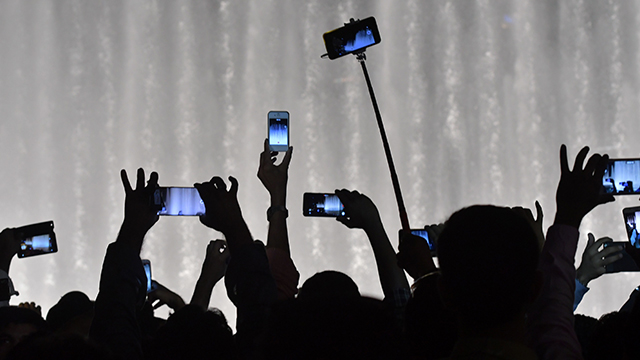
The iPhone turns 10 on June 29, and the moment warrants a look back at the broader story about the means mobile devices take inverse how people interact.
Hither are 10 findings about these devices, based on Pew Enquiry Center surveys:
1 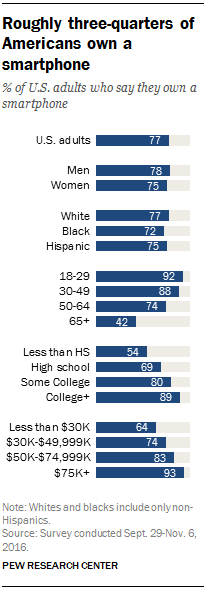 About iii-quarters of U.South. adults (77%) say they own a smartphone, upward from 35% in 2011, making the smartphone ane of the well-nigh quickly adopted consumer technologies in recent history. Smartphone ownership is more than common among those who are younger or more than flush. For instance, 92% of eighteen- to 29-twelvemonth-olds say they own a smartphone, compared with 42% of those who are ages 65 and older.
All the same, adoption rates have risen rapidly amidst older and lower-income Americans in recent years. From 2013 to 2016, the share of adults 65 and older who written report owning a smartphone has risen 24 pct points (from 18% to 42%). There has also been a 12-point increment in smartphone ownership amid households earning less than $xxx,000 per year: 64% of these lower-income Americans now own a smartphone.
2 Half of younger adults live in a household with three or more smartphones. More than than nine-in-x 18- to 29-twelvemonth-olds (96%) say they live in a household with at to the lowest degree one smartphone, and 51% of young adults say their home contains 3 or more such devices. Still, many older adults also live in households with multiple smartphones. For example, 39% of 30- to 49-year-olds and 29% of 50- to 64-year-olds say their dwelling house contains 3 or more smartphones. This is far less common, even so, amid those 65 and older, with just 11% saying it applies to their household.
iii Mobile devices aren't just for calling or texting. Americans are using their phones for a variety of nontraditional phone activities, such every bit looking for a task, finding a date or reading a book. Some 28% of U.South. adults said in a 2015 Pew Research Center survey that they have used a smartphone as part of a task search. This is especially common amid younger adults, with 53% of 18- to 29-year-olds reporting doing this.
Other Pew Research Center data evidence that 9% of U.S. adults say they accept used mobile dating apps, while the share of Americans who say they read an e-book using a cellphone within the past year increased from five% in 2011 to xiii% in 2016.
iv The smartphone is condign an important tool for shoppers. While around one-half of U.South. adults (51%) report making online purchases via their smartphone, many are also turning to their phones while in a concrete store. In a 2015 Pew Research Middle survey, 59% of U.Due south. adults say that they have used their cellphone to phone call or text someone while inside a shop to talk over purchases they are thinking of making. Simply under half (45%) accept used their phones while inside a store to expect upward online reviews or to attempt and observe a better price online for something they are thinking of purchasing. And a relatively pocket-sized share of Americans (12%) have used their cellphones to physically pay for in-store purchases.
v 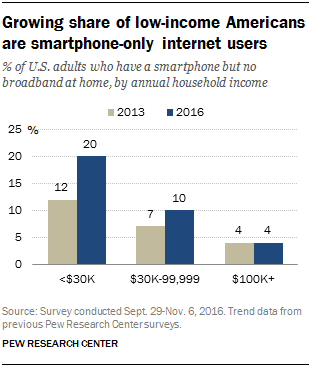 Growing shares of Americans – especially those who are lower-income – rely on smartphones to access the internet. Overall, 12% of U.South. adults were "smartphone-but" internet users in 2016 – meaning they owned a smartphone merely did not have broadband internet at dwelling house. This represents an increase from 8% in 2013. Reliance on smartphones to go online varies greatly by income. One-in-five adults whose almanac household income falls below $30,000 are smartphone-just cyberspace users, compared with simply 4% of those living in households earning $100,000 or more.
6 More than than half of smartphone owners say they go news alerts on their phones, just few get these alerts frequently. Some 55% of smartphone owners say they e'er get news alerts on their phones' screens, according to a 2016 Pew Enquiry Center survey. However, few users say they receive these types of alerts often, with but 13% of smartphone owners reporting doing this.
7 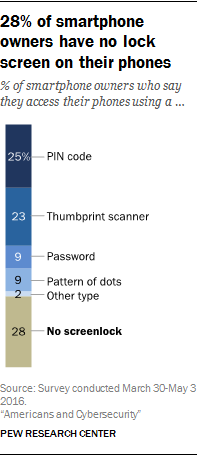 While smartphones are becoming more integrated into our lives, many users aren't taking the necessary steps to secure their devices. A 2016 Pew Research Eye survey plant that 28% of U.South. smartphone owners say they do not employ a screen lock or other features to secure their phone. Although a majority of smartphone users say they take updated their phone'due south apps or operating organisation, around four-in-10 say they only update when information technology'southward user-friendly for them. Merely some smartphone users forgo updating their phones altogether: 14% say they never update their phone's operating arrangement, while 10% say they don't update the apps on their telephone.
8 Smartphone ownership is climbing in developing nations, only the digital divide remains. Median smartphone adoption in developing nations rose to 37% in 2015, upwardly from 21% in 2013, according to a Pew Research Center survey of 21 emerging and developing nations conducted in 2015. Simply advanced economies notwithstanding have considerably higher rates of smartphone adoption, with the highest rates among surveyed countries found in South Korea, Sweden, Australia, holland and Spain. Effectually the world – including in avant-garde economies – a digital carve up in smartphone ownership nevertheless exists between the young and one-time, and between more than educated and less educated people.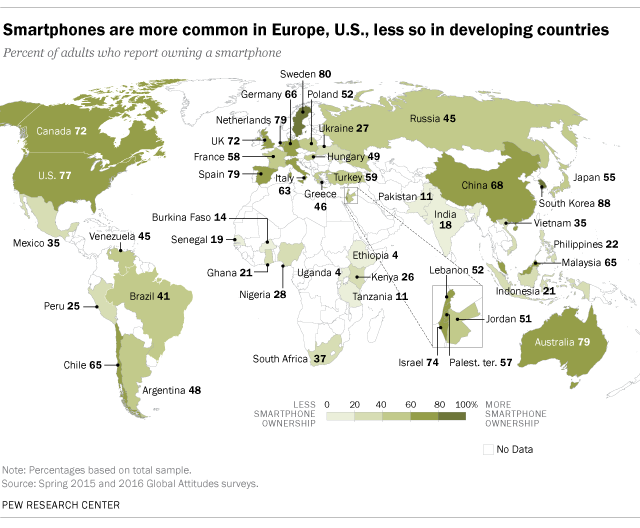
nine 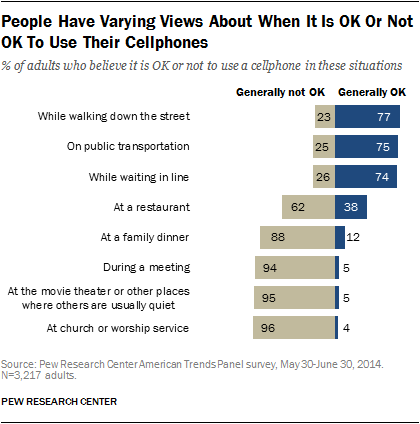 Americans have different views well-nigh where information technology is and isn't advisable to utilize a cellphone. In a 2014 Pew Research Center survey, roughly 3-quarters of adults said it was OK for people to use their phones while walking down the street, riding public transit or waiting in line, just far fewer found information technology acceptable to use cellphones during a meeting, at the movies or in church.
Regardless of how they feel about the appropriateness of using a telephone in social settings, an overwhelming bulk of mobile phone owners (89%) say they did employ their phones during their most contempo social gathering.
ten 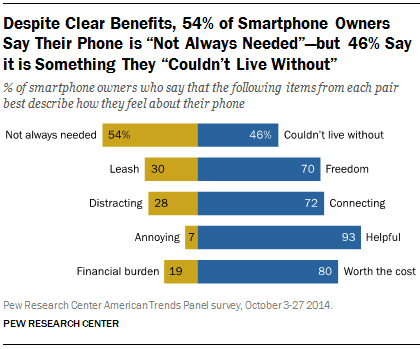 The smartphone is essential for many owners, but a slight majority says it's not e'er needed. Some 46% of smartphone owners said their smartphone is something "they couldn't live without," compared with 54% who said in a 2014 Pew Inquiry Centre survey that their telephone is "not e'er needed." Peradventure surprisingly, smartphone owners who depend on their mobile device for net access are not significantly more inclined than those who take multiple options for going online to say they couldn't alive without their phone (49% vs. 46%).
In improver to being essential for many, smartphone owners are much more than likely to have positive views of these devices. For instance, they are much more likely to say smartphones are more than helpful than annoying, represent freedom rather than represent a leash, enable connecting rather than being distracting and are worth the cost rather than existence a financial burden.
Note: The figures and map on global smartphone adoption were updated June 29, 2017, to include more contempo information.

Andrew Perrin is a inquiry annotator focusing on net and engineering at Pew Inquiry Center.
Source: https://www.pewresearch.org/fact-tank/2017/06/28/10-facts-about-smartphones/
0 Response to "Nemzeti Olvasottsãƒâ¡g Kutatãƒâ¡s (National Survey on Reading Habits)"
Post a Comment